Coastal Mold and Marine Layer Dust in San Diego Homes
TL;DR
San Diego’s marine layer fog deposits sodium chloride (NaCl) and magnesium chloride (MgCl₂) aerosols on home surfaces daily. These salt compounds form ionic bonds with paint, grout, and porous surfaces that standard wiping cannot break. La Jolla, Coronado, Del Mar, Pacific Beach, and Encinitas face the highest exposure. May and June are the peak deposition months. Steam at 275°F breaks the ionic bonds through steam cleaning — the mechanism that distinguishes it from wiping or standard mopping.
Jason Ellis, Owner
Bravo Maids San Diego · 8+ years high-heat steam clean protocols · Our editorial standards →
Published: May 21, 2026
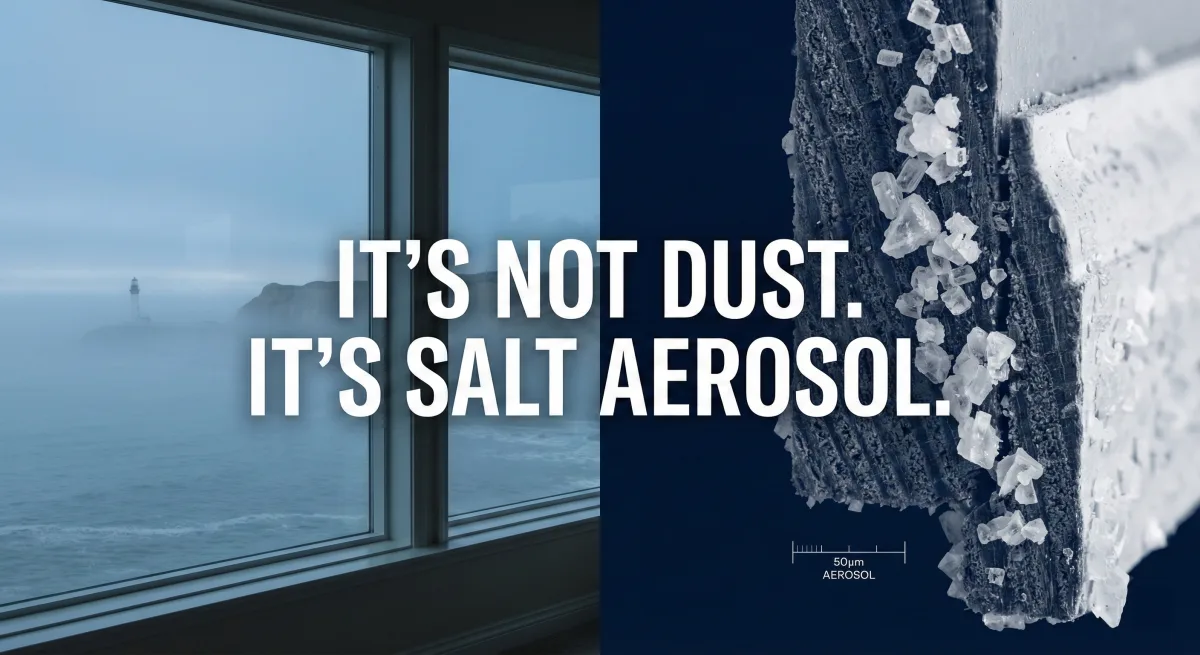
What Marine Layer Fog Actually Deposits on San Diego Surfaces
What does San Diego's marine layer fog deposit on home surfaces?
San Diego's marine layer deposits sodium chloride (NaCl) and magnesium chloride (MgCl₂) aerosols on baseboards, window tracks, HVAC vents, and countertops daily. These ionic compounds form electrostatic bonds with painted and porous surfaces that standard wiping cannot break. Steam at 275°F disrupts the ionic bond through steam cleaning — the mechanism that distinguishes professional cleaning from standard mopping.
Most San Diego residents know the marine layer as a visual phenomenon — the gray overcast that burns off by noon in summer. What fewer people think about is what the fog leaves behind when it evaporates.
Marine layer fog forms when moist Pacific air flows onshore and cools over the cold California Current. That air carries salt aerosol particulates from the ocean surface: primarily sodium chloride (NaCl) and magnesium chloride (MgCl₂), the dominant salts in seawater. As fog condenses on surfaces and then evaporates, it deposits these compounds as microscopic crystals.
The primary salt in seawater. Forms ionic bonds with paint, grout, and porous surfaces. Hygroscopic — it absorbs ambient humidity and remains in a semi-dissolved state on surfaces rather than crystallizing cleanly, which is why affected surfaces often feel tacky or film-coated even when dry.
More hygroscopic than NaCl, meaning it holds more moisture at equivalent humidity levels. MgCl₂ deposits are especially problematic in bathroom environments where humidity is already elevated — the compound never fully dries, feeding ongoing embedded build-up formation in grout and around fixtures.
Beyond salt, marine layer air carries biological particulates from ocean surface microlayer: fungal spores, bacterial cells, and organic matter aerosolized from breaking waves. These particulates ride salt aerosols inland and deposit on the same surfaces, contributing to the embedded build-up and mold conditions in coastal homes.
Definition
Ionic Bond (surface chemistry)
An electrostatic attraction between oppositely charged ions. When salt aerosols from the marine layer — primarily sodium chloride (NaCl) and magnesium chloride (MgCl₂) — land on painted or porous surfaces, their chloride ions (negative charge) bond to localized positive charges in paint and grout. This bond is stronger than the adhesion a wet cloth exerts, which is why standard wiping smears deposits rather than removing them.
The chemistry that makes marine layer deposits difficult to remove is ionic bonding. Chloride ions from NaCl and MgCl₂ carry a negative charge. Many common paint formulations and calcium-based materials like grout carry localized positive charges at their surface. The two bind electrostatically — a bond that is stronger than the adhesion between a wet cloth and the deposit.
This is why wiping a window that has accumulated marine layer haze with a damp cloth often smears rather than removes. The cloth displaces surface crystals but cannot break the ionic bond layer underneath. Surfactants work by inserting a polar molecule between the ionic compound and the surface, effectively crowding out the electrostatic bond. Steam works differently — thermal energy disrupts the bond directly by increasing molecular vibration beyond the bond’s tolerance.
Salt aerosols form ionic bonds with painted surfaces that water alone cannot break — steam at 275°F disrupts the electrostatic bond directly through steam cleaning.
Most Affected San Diego Neighborhoods
Marine layer exposure varies significantly across San Diego based on distance from the coast, elevation, and local topography. Here is how the main coastal communities compare.
Ocean-facing sandstone cliffs channel and accelerate onshore airflow directly into residential neighborhoods. The elevation concentrates marine layer contact. Bird Rock, Windansea, and the Shores districts face direct salt aerosol deposition nearly year-round. During May–June, the marine layer regularly persists past noon.
Primary risk: Salt aerosol ionic bonding on all exterior-facing surfaces; accelerated grout embedded build-up in high-humidity bathrooms.
Low elevation and direct ocean access with minimal topographic barrier between the Pacific and residential streets. The San Dieguito River valley creates a natural funnel for marine air inland. Fog frequently settles below the bluff level, maintaining high relative humidity in neighborhoods between Highway 101 and the lagoon.
Primary risk: High humidity accelerates mold formation in bathroom grout and under-sink cabinets; salt deposits on window glass and tracks.
Bay-side and ocean exposure from two directions creates a marine layer environment that differs from pure coastal neighborhoods. Mission Bay to the east and the Pacific to the west mean moisture and aerosol deposition occur from multiple vectors. The flat topography allows fog to penetrate blocks inland without elevation loss.
Primary risk: Dual-direction humidity exposure; HVAC systems concentrate particulates from both bay and ocean air; baseboard deposits throughout ground-floor spaces.
Surrounded by water on three sides — San Diego Bay to the east, the Pacific to the west, and the Silver Strand connecting south. Salt aerosol deposition is nearly constant and comes from multiple directions depending on wind. The island's low elevation (no hills to block marine air) means fog exposure affects the entire land mass uniformly.
Primary risk: Constant multi-directional salt deposition; accelerated corrosion on metal fixtures; embedded build-up in grout across all bathrooms, not just primary baths.
Elevated coastal bluffs increase direct contact with marine layer fog as it moves onshore. Leucadia, Olivenhain, and Cardiff-by-the-Sea vary in exposure based on proximity to the cliff edge. Homes west of Interstate 5 face significantly higher marine layer contact than those to the east. Bluff-top properties experience conditions closer to La Jolla than inland Encinitas.
Primary risk: Elevation amplifies salt aerosol concentration; bluff-facing windows accumulate mineral deposits faster than lower-elevation coastal sites.
Mission Valley, El Cajon, Santee, La Mesa, and similar inland communities sit behind topographic barriers that reduce marine layer penetration. While fog occasionally reaches inland during peak June Gloom, salt aerosol concentration drops significantly within 5–10 miles of the coast. These neighborhoods face standard household dust accumulation rather than the ionic salt deposition pattern of coastal areas.
Primary risk: Standard particulate dust; seasonal wildfire smoke during September–November offshore wind events; significantly lower marine layer-related surface deposits.
La Jolla represents the high end of coastal salt aerosol exposure in San Diego County. The combination of ocean-facing sandstone cliffs, persistent marine layer contact, and architectural features that trap fog — recessed entryways, canyon-adjacent lots, north-facing windows — means that salt deposits accumulate faster and bond more aggressively than in other coastal neighborhoods.
In La Jolla homes, baseboard deposits are often visible within two weeks of cleaning without intervention. Window tracks require more frequent attention than glass, because the track geometry accumulates evaporated salt while the glass surface sheds it via condensation runoff. Grout in bathrooms facing seaward elevations shows accelerated embedded build-up formation compared to interior bathrooms in the same home.
Most Impacted Surfaces
Marine layer deposition does not affect all surfaces equally. Geometry, material porosity, and position in the home determine how quickly salt aerosols accumulate and how difficult they are to remove.
| Surface | Why Affected |
|---|---|
| Baseboards | Salt aerosols settle at floor level by gravity. Ionic bonds form with latex paint, especially on porous or aged surfaces. Embedded Build-Up forms at the bond layer over time. |
| Window tracks | Fog condenses on cold aluminum or vinyl, depositing dissolved salt as the water evaporates. Sediment and particulates accumulate in grooves where airflow slows. |
| HVAC vents | Air intake concentrates particulates from the marine layer across the entire air volume of the home. Salt crystals and humidity-bound dust accumulate on vent louvers and in duct openings. |
| Countertops | Daily fog deposition settles on horizontal surfaces. Grout lines, textured stone, and unsealed granite trap microscopic particulates. Repeated deposition without removal degrades sealants. |
| Bathroom grout | Combined humidity from marine layer and shower use creates sustained moisture in grout channels. Salt content from aerosols accelerates embedded build-up formation, which grout porosity then anchors. |
| Exterior-facing window glass | Evaporating fog leaves NaCl and MgCl₂ crystal residue on glass. Repeated deposition builds a mineral film that refracts light and reduces clarity. |
Wet-wipe with appropriate surfactant to break ionic bond; follow with dry microfiber to prevent secondary deposition.
Steam extraction at 275°F loosens compacted sediment; narrow nozzle clears grooves; follow with surfactant wipe.
Filter replacement on schedule; vent louver wipe with damp microfiber; duct opening inspection for heavy deposits.
Regular surface treatment with appropriate cleaner matched to countertop material; sealer maintenance on porous stone.
275°F steam cleaning lifts embedded build-up from the embedded build-up matrix; steam penetrates grout pores where brushing alone cannot reach.
Appropriate glass cleaner with mild acid component to dissolve mineral scale; squeegee technique to prevent streaking.
A common observation in coastal homes is that baseboards appear to accumulate a grayish film faster than countertops or upper wall surfaces. This is explained by the settling behavior of aerosol particles. Salt aerosols behave like fine particulate matter — they lose velocity as they travel and settle onto horizontal or low-position surfaces under the influence of gravity and electrostatic attraction.
Baseboards near exterior walls are also exposed to the infiltration boundary: the zone where conditioned indoor air meets air leaking in around door frames, electrical outlets, and window sills. This infiltration carries a higher concentration of outdoor aerosols than the center of a room. The result is baseboard deposits that can be 2–3 times denser than surface deposits at counter height in the same room.
The June Gloom Seasonal Pattern
Marine layer intensity follows a predictable annual cycle in San Diego. Understanding the pattern helps coastal homeowners plan cleaning frequency around peak deposition periods.
The marine layer is most persistent, often remaining onshore until mid-afternoon or all day. Fog formation is driven by cold California Current upwelling combined with warm inland air. Salt aerosol deposition and humidity-bound particulate accumulation are highest during this window.
As the thermocline strengthens, the marine layer burns off earlier each morning, often by 9–10 AM by July. Fog frequency decreases but the marine layer is still present on most nights and early mornings. Deposition continues but at lower intensity than peak June Gloom.
Santa Ana conditions bring dry winds from the inland desert toward the coast, reversing the typical onshore flow pattern. During Santa Ana events, relative humidity drops to 10–20% and marine layer fog is absent. This is the lowest-deposition period for coastal salt aerosols. Wildfire smoke becomes a distinct particulate concern during this window.
Winter storms interrupt the marine layer pattern with rain events that temporarily rinse surface deposits. Between storms, onshore fog returns. The marine layer is less persistent than summer months but still contributes to ongoing salt aerosol deposition, particularly in La Jolla and Coronado.
June Gloom is driven by the interaction between the North Pacific High pressure system and the cold California Current. In late spring and early summer, the High moves north and strengthens, pushing moist marine air onshore at low levels while subsiding dry air aloft prevents the marine layer from rising and dissipating. The result is a persistent low-level stratus deck that can sit at 500–2,000 feet elevation, well below the coastal hills but covering the flat coastal terrain.
From a deposition standpoint, this configuration is the worst case for coastal homes. The marine layer makes multiple contact cycles per day — rolling in overnight, condensing on surfaces, partially evaporating midday, then reforming by evening. Each condensation-evaporation cycle deposits a new layer of salt concentrate. Over the course of a week of persistent June Gloom, a La Jolla home can accumulate the equivalent of several weeks of standard seasonal deposition.
The Santa Ana reversal in fall offers a respite. When offshore winds bring dry desert air toward the coast, relative humidity drops sharply and the marine layer retreats entirely. Any salt deposits on surfaces will dehydrate into a brittle crystal form that is actually easier to remove than the semi-hydrated ionic film that persists during humid marine layer conditions.
How Steam Cleaning Addresses Marine Layer Deposits
The mechanism by which 275°F steam addresses salt aerosol deposits is distinct from both dry wiping and surfactant-based cleaning. Understanding the chemistry explains why the method matters — not just that it works. The EPA's guidance on mold confirms that surface moisture control and thermal disruption are the primary prevention strategies for coastal mold buildup.
At 275°F, steam molecules carry sufficient kinetic energy to disrupt ionic bonds at the molecular level. The rapid thermal input exceeds the binding energy of NaCl and MgCl₂ deposits on paint and grout, effectively breaking the attachment without abrasion.
Pressurized steam in vapor form penetrates grout pores, window track grooves, and baseboard surface texture that a wiping cloth cannot reach. This addresses deposits at depth, not just surface-level crystals that standard cleaning methods access.
Abrasive cleaning of salt-crystallized surfaces risks micro-scratching finishes, which creates more surface area for future deposits to bond to. Steam lifts without abrasion, preserving the integrity of the surface and reducing subsequent deposition rates.
When a wet cloth contacts a salt-deposited surface, it introduces water that temporarily dissolves surface crystals. But unless the cloth applies sufficient friction to physically remove the ionic compound — which requires force that risks abrasion — the water evaporates and the salt recrystallizes in the same position. The deposit remains.
Steam introduces a different mechanism. At 275°F, the vapor transfers thermal energy to the surface rapidly. This thermal input agitates the ionic lattice of the deposited salt compound, increasing molecular vibration beyond the threshold of the bond between the compound and the surface. The deposit lifts, and the subsequent steam moisture carries it away from the surface in suspension rather than letting it redeposit.
For embedded build-up in grout — which is a biological matrix that NaCl and MgCl₂ deposits accelerate — the steam cleaning mechanism is even more decisive. Embedded Build-Up is a community of bacteria or mold spores embedded in a self-produced polymer matrix. Steam at 275°F disrupts the protein structure of the embedded build-up matrix, breaking it down and allowing it to be extracted from the grout pore. For a detailed breakdown of the science, see our steam cleaning science page.
Bathroom grout in La Jolla, Coronado, and Del Mar homes faces a compounding problem. Marine layer humidity keeps relative humidity elevated even in interior spaces, particularly in bathrooms that are not aggressively ventilated. This baseline humidity, combined with the hygroscopic MgCl₂ that arrives via aerosols through doorways and HVAC systems, creates sustained moisture in grout channels.
The result is accelerated embedded build-up formation. What might take months to develop in an inland San Diego bathroom can appear within weeks in a Coronado or Encinitas coastal home. Grout sealers help slow the process but do not eliminate it — microscopic sealant discontinuities still allow aerosol penetration over time. Professional steam treatment followed by fresh sealant application is the intervention that addresses both the existing embedded build-up and reduces the surface’s vulnerability to the next deposition cycle.
Frequently Asked Questions
What does San Diego marine layer fog actually deposit on home surfaces?
Marine layer fog deposits sodium chloride (NaCl) and magnesium chloride (MgCl₂) aerosols, microscopic particulates from sea spray, and humidity-bound sediment. These ionic compounds settle on baseboards, window tracks, HVAC vents, and countertops. They form ionic bonds with painted and porous surfaces that water alone cannot break.
Which San Diego neighborhoods have the worst marine layer exposure?
La Jolla has the highest exposure due to ocean-facing cliffs that concentrate onshore airflow. Coronado is surrounded by water on three sides, making salt aerosol deposition nearly constant. Del Mar and Pacific Beach sit at low elevation with direct ocean access. Encinitas faces elevated coastal exposure from its bluff positions. Inland neighborhoods like Mission Valley, El Cajon, and Santee see significantly lower marine layer sediment.
When is June Gloom worst in San Diego, and does it affect cleaning frequency?
June Gloom peaks from May through June when the marine layer is most persistent, often staying onshore until mid-afternoon or all day. Fog frequency drops from July through September as the thermocline strengthens and the marine layer burns off earlier. October through December brings offshore Santa Ana flow, which dramatically reduces coastal salt aerosol deposition. Coastal homeowners in La Jolla, Del Mar, and Coronado benefit most from increased cleaning frequency during May–June.
Why doesn't regular wiping remove marine layer salt deposits from baseboards?
Salt aerosols form ionic bonds with the painted or porous surfaces they land on. Sodium chloride and magnesium chloride molecules bond at the ionic level to paint, grout, and finished wood. Dry wiping pushes the salt laterally and can scratch surfaces. Water alone may dissolve surface crystals but doesn't penetrate the bond layer. An appropriate surfactant disrupts the ionic bond. Steam at 275°F simultaneously breaks the bond through steam cleaning and lifts the compound without abrasion.
How often should coastal San Diego homes be professionally cleaned because of marine layer?
Homes in La Jolla, Coronado, and Del Mar with significant ocean exposure typically accumulate visible salt haze on windows and surfaces within 7–14 days during peak marine layer season. Bi-weekly professional cleaning addresses buildup before ionic bonds strengthen. Pacific Beach and Encinitas homes at moderate exposure generally benefit from monthly professional cleaning year-round, with increased frequency during June Gloom. Inland neighborhoods face little marine layer-specific cleaning pressure.
Schedule a Coastal Deep Clean
If your home is in La Jolla, Del Mar, Pacific Beach, Coronado, or Encinitas, marine layer deposits are accumulating on your surfaces between cleanings. Our cleaners use 275°F steam cleaning to break the ionic bonds that standard wiping cannot reach. Serving all coastal San Diego neighborhoods.
Mon–Fri 8 AM – 6 PM | Sat 9 AM – 4 PM | hello@bravomaids.com
Ready for a Cleaner Home?
Book your first cleaning today and discover why San Diego families trust Bravo Maids for a healthier, happier home.
Family-owned · Free quotes · Flexible scheduling · 100% satisfaction guaranteed
Last reviewed: October 2026