Deep Cleaning Checklist: 73 Tasks, Room by Room (San Diego Edition)
Last Updated: May 2026
The short answer: A true deep clean covers 73 distinct tasks across your kitchen (25), bathrooms (18), living areas (12), bedrooms (10), and garage/patio (8). Most San Diego homes that haven't been professionally deep-cleaned in 30+ days need every one of them. Save this page or print it — then use it to benchmark the work, whether you do it yourself or hire a professional. Read our signs you need a deep cleaning guide first if you are not sure where you stand.
A deep cleaning checklist is not the same as a standard cleaning list with a few extra items bolted on. It is a fundamentally different scope — one that addresses the layers of contamination that accumulate over weeks and months, not the surface film that builds up between regularly scheduled visits.
In San Diego, this distinction matters more than in most cities. Salt aerosol from the Pacific coast settles on horizontal surfaces from La Jolla down through Coronado and Pacific Beach, creating an ionic bond that attracts moisture and traps particulate in adhesive layers. Combined with the marine-layer humidity that keeps bathrooms damp longer than in inland markets, embedded build-up colonizes grout and caulk faster here than nearly anywhere else in California. That same coastal humidity also accelerates dust mite colonization in carpets and bedding, compounding allergen load between deep cleans.
The result: a deep cleaning checklist built for San Diego homes has to account for conditions that a generic national list ignores. This one does. Work through it room by room.
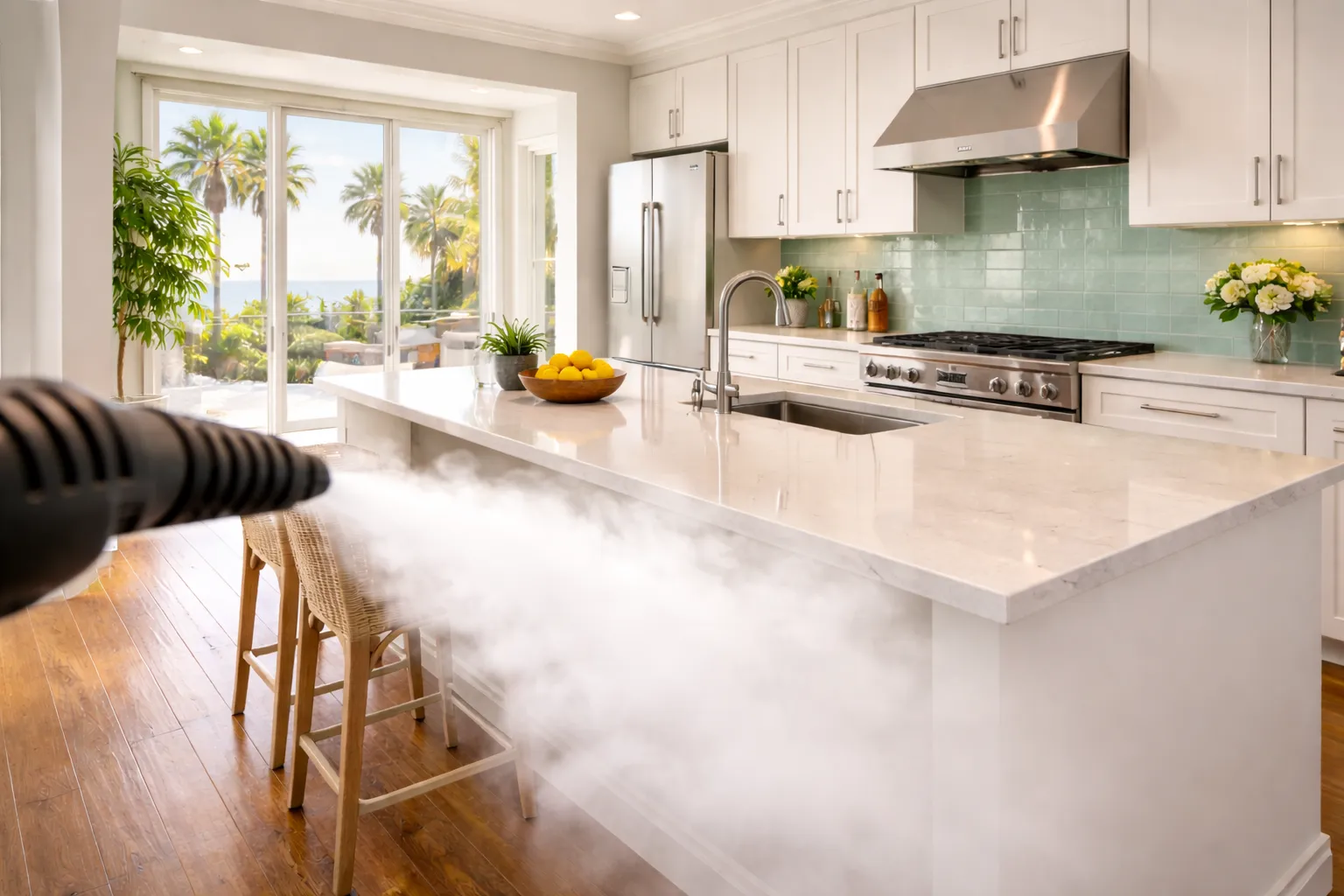
What Should You Include in a Deep Cleaning Checklist?
A proper house deep cleaning checklist goes well beyond wiping surfaces. The three categories that separate a true deep clean from a maintenance clean are:
Behind and underneath — not just on top
Refrigerators pulled from walls, toilets cleaned behind the tank base, furniture pulled away from baseboards, oven interiors fully accessed. If it only happens once or twice a year, it belongs on this list.
Embedded Build-Up and grease extraction — not redistribution
Grout lines scrubbed, range hood filters degreased, backsplash tile treated, caulk edges addressed. These require dwell time and physical agitation, not a quick spray-and-wipe pass.
High-touch surfaces deep-cleaned — not just dusted
Light switch plates, outlet covers, door handles, faucet aerators, remote controls, and appliance buttons. These carry the highest grime and build-up load in any home and are routinely skipped in standard visits. The EPA notes that indoor air can be 2–5× more polluted than outdoor air, making thorough surface treatment critical for home health.
With those three principles in mind, here is the full 73-task deep clean house checklist, organized by room.
Kitchen Deep Cleaning Checklist (25 Tasks)
The kitchen generates the highest contamination density of any room: airborne grease from cooking bonds to every surface within six feet of the range. Combined with food-prep bacteria and moisture from the sink, the kitchen demands the most thorough treatment on any deep clean checklist.
Degrease all exterior appliance surfaces including sides and tops
Use a food-safe degreaser with 5-minute dwell time — spray-and-wipe without dwell time moves grease laterally rather than lifting it.
Clean inside the oven — racks removed, interior walls, door glass both sides
Oven door glass has an interior panel accessible by removing the door hinge pins on most models. It is almost always contaminated.
Degrease and rinse range hood filters
Mesh filters should be soaked in hot water and degreaser for 15+ minutes. A visibly clean filter still retains up to 30% grease load.
Wipe range hood interior housing and fan blades
The interior housing accumulates a thick grease film that drips onto the range below if left unchecked.
Deep-clean kitchen sink basin and drain, including the overflow port
The drain overflow port is rarely cleaned and harbors heavy embedded build-up. Use a bottle brush and a steam-cleaning agent.
Descale faucet aerator — remove and soak in white vinegar
San Diego hard water deposits calcite rapidly. A fully blocked aerator reduces flow pressure enough to be misdiagnosed as a plumbing issue.
Wipe all cabinet faces, door edges, and hardware pulls
Cabinet door edges accumulate finger-oil buildup that standard cleaning misses. Focus on the lower cabinets, highest-touch zone.
Wipe drawer interiors and liner surfaces
Food crumbs and moisture in drawer liners feed pests. Remove items, vacuum, wipe with steam-cleaning solution.
Clean inside the refrigerator — all shelves, drawers, and door bins removed
Drawers should be washed in the sink, not wiped in place. The compressor fan cover under the produce drawers collects debris.
Vacuum refrigerator condenser coils (usually behind the kickplate)
Clogged condenser coils increase compressor wear and energy draw by up to 25%. A 0.3-micron HEPA vacuum prevents blowing dust into the kitchen air.
Deep-clean all countertop surfaces with a food-safe cleaner after degreasing
Steam-Cleaning without degreasing first is ineffective — steam-cleaning agents cannot penetrate grease film to contact the surface below.
Degrease backsplash tile and steam or scrub grout lines
Kitchen backsplash grout is one of the fastest-colonizing embedded build-up surfaces in the home, due to the combination of moisture, heat, and cooking aerosols.
Clean inside the microwave — turntable removed, interior ceiling and walls
Splatter on the microwave ceiling is often overlooked and carbonizes over successive uses, making it progressively harder to remove.
Polish stainless steel appliance surfaces with the grain
Cross-grain polishing creates micro-scratches that trap grease. Always use a microfiber cloth moving in the direction of the brushed grain.
Clean the garbage disposal — ice and salt scrub, citrus deodorize
The underside of the rubber splash guard is the most contaminated part of any kitchen sink and is almost never addressed in standard visits.
Clean and deep-clean garbage can interior and lid
Kitchen trash cans should be fully emptied, rinsed, and treated with a cleaning agent at minimum quarterly. Most households do this annually at best.
Wipe down and deep-clean all small appliances — toaster, coffee maker, blender base
Toaster crumb trays are a common pest attractant. Coffee maker water reservoirs require descaling every 1–3 months in San Diego hard water conditions.
Clean pantry shelves — remove items, wipe liner, check for expired goods
One expired item can contaminate shelf liner with moisture and encourage mold or pest activity.
Deep-clean cutting board storage area and any knife blocks
Knife block slots are rarely cleaned and accumulate food debris. Lay blocks flat, tap debris out, clean slots with a bottle brush.
Clean dishwasher interior — spray arms, filter, and door gasket
The dishwasher filter is the most neglected maintenance item in most kitchens. A clogged filter recirculates food debris onto 'cleaned' dishes.
Wipe ceiling light fixtures and replace any burned bulbs
Kitchen light fixtures accumulate grease mist from cooking. A clean fixture can increase perceived brightness by 20–30%.
Deep-clean all high-touch surfaces — light switches, outlet plates, door handles
Clean window above sink — glass, frame, and sill
Kitchen window sills collect grease and moisture and are a common spot for early mold development in San Diego homes.
Wipe baseboards and toe-kicks on all cabinet runs
Steam mop or scrub tile floor — grout lines included
275°F thermal shock via steam is the most effective tool for kitchen floor grout lines without chemical agents. Wide-plank wood floors should not be steam-treated.
Bravo Maids' Asset Reset covers every item on this list. Professional deep cleaning starts at $285. Transparent flat-rate pricing — no hourly surprises.
View Deep Cleaning ServiceBathroom Deep Cleaning Checklist (18 Tasks)
Bathrooms present the highest embedded build-up risk of any room in the home. The combination of warm showers generating humidity, porous grout and caulk providing colonization surfaces, and daily human contact creates conditions where a standard wipe-down is almost meaningless after 30 days without professional intervention. In coastal San Diego neighborhoods like Pacific Beach and Coronado, marine-layer humidity extends bathroom drying time significantly, accelerating mold and embedded build-up development.
Apply descaler to toilet bowl and allow 10-minute dwell time before scrubbing
San Diego hard water deposits calcium carbonate rings that require acid-based descalers (citric or phosphoric acid). Standard toilet bowl cleaners are surfactant-only and will not dissolve mineral rings.
Scrub toilet exterior — base, floor contact perimeter, behind tank, and tank exterior
The floor perimeter around the toilet base is the highest-contamination zone in the bathroom and the most commonly skipped area.
Remove and soak showerhead in white vinegar to descale flow ports
A showerhead with 30% blockage by calcium is functionally delivering the same pathogen load into steam as a clean one, but concentrating it differently. Descaling takes 20–30 minutes submerged.
Scrub shower/tub grout lines — apply 275°F thermal shock treatment via steam
Grout is inherently porous and embedded build-up cannot be fully removed by surface scrubbing alone. Thermal shock (275°F steam) at the grout surface lifts embedded build-up from established embedded build-up deposits. Wide-plank natural stone excluded.
Scrub shower/tub caulk lines and assess for replacement if blackened
Blackened caulk has subsurface mold penetration that cannot be treated topically. Caulk with visible black streaks below the surface needs removal and reapplication.
Clean exhaust fan cover — remove, wash, and ensure fan is functioning
A clogged exhaust fan reduces humidity evacuation and directly increases embedded build-up and mold development rates. The fan cover accumulates dust that eventually restricts airflow entirely.
Wipe all tile wall surfaces — not just the tile face, but grout lines and corners
Deep-clean sink basin, drain, and overflow port
The drain overflow port in bathroom sinks is functionally identical to the kitchen sink situation — almost universally ignored in standard visits.
Clean mirror — lint-free cloth, two-pass technique (horizontal then vertical)
Deep-clean all light switch plates and outlet covers
Clean shower door tracks — remove doors if possible and clear all debris from channels
Shower door tracks are an embedded build-up reservoir that is nearly impossible to reach in situ. A flexible brush and hydrogen peroxide are required.
Clean inside medicine cabinet — remove items, wipe all surfaces and hinges
Deep-clean soap dish, toothbrush holder, and countertop accessories
Soap dishes accumulate a slurry of soap scum, body oil, and bacteria that is often more contaminated than the toilet seat in a regularly used bathroom.
Wipe down vanity cabinet exterior, hardware, and inside drawer faces
Deep-clean trash can interior and lid
Clean window sill, frame, and blinds — dry then damp
Bathroom window sills accumulate salt aerosol and humidity residue, particularly in homes within 2 miles of the coast.
Wipe baseboard and quarter round — deep-clean, do not just dust
Mop floor after all surfaces are complete — treat grout with appropriate product
Mopping before completing wall and surface work will require re-mopping. Always work top to bottom, surfaces before floor.
Living Areas Deep Cleaning Checklist (12 Tasks)
Living rooms and common areas are low-humidity zones, which slows embedded build-up development significantly. The primary contamination drivers here are particulate accumulation in upholstery, dust stratification on horizontal surfaces, and salt aerosol adhesion to windows and sills. Homes in La Jolla Farms, Coronado Cays, or anywhere directly on the coast will see significantly heavier salt aerosol load on blinds and window frames than inland San Diego neighborhoods.
Vacuum all upholstered furniture — cushions removed, sides, and underneath
Under-cushion vacuuming regularly surfaces enough debris to warrant a full deep clean on its own. Use the crevice tool in all seams.
Pull all furniture from walls — vacuum and clean floor underneath and behind
Dust ceiling fan blades — damp wipe, do not just dry-dust
Dry-dusting ceiling fan blades recirculates particulate into room air. A damp microfiber collar or pillowcase technique captures it.
Wipe baseboards and crown molding — full perimeter
Baseboards in San Diego living rooms accumulate salt aerosol and pet hair in a bonded layer that dry dusting will not remove.
Clean window sills, tracks, and weep holes
Window tracks and weep holes accumulate debris that eventually impedes drainage and contributes to moisture intrusion. Use a stiff brush and vacuum before wiping.
Vacuum window blinds or launder washable curtains
Deep-clean light switches, outlet plates, and remote controls
Dust all shelving, book spines, picture frames, and decorative objects
Books and shelving are among the highest-load dust surfaces in a home due to their large combined surface area and rarely disturbed status.
Clean all glass surfaces and mirrors — streak-free two-pass method
Vacuum area rugs thoroughly or carry outside and beat before vacuuming
A 0.3-micron HEPA vacuum is required to capture the fine particulate embedded in area rug fibers — particularly silica sand in homes near Mission Beach, Pacific Beach, or Ocean Beach.
Wipe all door frames, handles, and light switch covers
Clean fireplace surround and hearth — remove ash, wipe stone or tile face
If the fireplace has not been used recently, this still applies for ash residue and surface dust accumulation on the mantle.
Bedroom Deep Cleaning Checklist (10 Tasks)
Bedrooms accumulate skin cell debris (a primary dust mite food source), fine particulate from open windows, and pet dander in homes with animals that are allowed on furniture. The mattress is the single highest-biomass surface in most homes and is almost never addressed in standard cleaning visits.
Launder duvet cover, pillow shams, pillow protectors, and bed skirt
Pillow protectors should be washed monthly. Duvet covers quarterly at minimum. Most homeowners wash them annually at best, which means the pillow and duvet are carrying 12 months of skin cell accumulation.
Vacuum mattress — top, sides, and handle areas with upholstery tool
The average mattress accumulates 1–2 pounds of skin cells annually. Mattress vacuuming with a HEPA-equipped machine significantly reduces dust mite populations.
Pull bed frame and nightstands from walls — clean underneath and behind
The wall-adjacent side of a bed is one of the highest pet-hair and debris accumulation zones in any home with animals.
Dust all flat surfaces — dresser tops, nightstands, shelving, top of wardrobe
Top-of-wardrobe surfaces are rarely dusted in standard visits and accumulate substantial stratified dust that falls when the doors are opened.
Wipe baseboards, door frames, and window sill
Clean window blinds or curtains
Vacuum closet floor, shelves, and hanging section base
Closet floors accumulate the same debris as bedroom floors but are almost never addressed in standard visits. Shoes deposit significant debris.
Wipe mirror surfaces — full-length and dresser mirrors
Deep-clean nightstand surfaces, lamp bases, and bedside hardware
Vacuum carpet, treating edges and under-furniture zones
Carpet edges — the 6-inch band against baseboards — accumulate particulate at 3–4x the rate of open floor areas due to airflow dynamics. Dedicated edge passes are required.
Garage and Patio Deep Cleaning Checklist (8 Tasks)
The garage and patio are often excluded from a house deep cleaning checklist entirely. In San Diego, where outdoor living and entertaining are year-round activities and where salt aerosol accelerates corrosion on metal hardware and outdoor furniture frames, this is a meaningful omission. Include these eight items for a complete scope.
Sweep and blow out garage floor — remove all debris before any wet treatment
Wipe garage door interior panels — remove cobwebs, dust, and salt aerosol deposits
Garage doors within 3 miles of the San Diego coast show accelerated salt corrosion on hinge hardware and panel creases. Wiping and applying a light protectant extends door longevity.
Organize storage shelves — remove items, wipe shelves, return organized
Clean outdoor furniture surfaces — degrease and wipe all frame and fabric surfaces
Outdoor furniture fabric accumulates salt aerosol, sunscreen residue, and airborne particulate from I-5 and I-8 corridor traffic that carries well into residential neighborhoods.
Sweep or pressure-wash patio or deck surface
Clean outdoor light fixtures — remove covers, wipe, replace any burned bulbs
Deep-clean garbage and recycling bin exteriors
Bin exteriors accumulate contamination from trash handling that transfers to hands and surfaces on contact. A simple hose-and-wipe passes enough surface bacteria to warrant deep-clean at each deep clean.
Remove salt aerosol buildup from exterior door hardware — hinges, handles, knockers
Salt deposits on exterior hardware are the primary cause of premature corrosion on doors in La Jolla, Coronado, and Pacific Beach homes. A citric acid solution removes deposits without damaging finishes.
How Often Should You Deep Clean Your San Diego Home?
The general answer is every 3–6 months, but San Diego homes compress that timeline based on proximity to the coast and household composition.
Every 3 Months (Quarterly)
- • Within 2 miles of the coast (La Jolla, Coronado, PB, OB)
- • Homes with pets
- • Households with young children
- • Anyone with allergies or respiratory conditions
Every 6 Months (Biannual)
- • Inland San Diego neighborhoods (Poway, Scripps Ranch, El Cajon)
- • 1–2 person households without pets
- • Homes with active weekly recurring maintenance cleaning
If your home has not been professionally deep-cleaned in 12+ months, review our signs you need a deep cleaning guide first — the scope required may be more extensive than a standard deep clean.
Deep Cleaning Checklist — Frequently Asked Questions
What is the difference between a deep clean checklist and a regular cleaning checklist?
A regular cleaning checklist covers maintenance tasks — the surfaces and areas you address every one to two weeks to prevent buildup. A deep clean checklist addresses the accumulation that maintenance cleaning misses: behind appliances, inside appliances, grout lines, under furniture, oven interiors, mattress surfaces, and all high-touch hardware. Think of regular cleaning as maintaining the baseline and deep cleaning as resetting it.
How long does a full deep clean take?
A 73-task deep clean on a standard 2-bedroom, 2-bathroom San Diego home typically takes a solo Certified Cleaning Specialist 6–8 hours, or a two-person team 3–4 hours. Larger homes, homes with significant grout or oven buildup, or homes that haven't been deep-cleaned in over a year will require additional time. Professional deep cleaning on a time-estimate basis often under-scopes the kitchen and bathrooms, which is why Bravo Maids uses flat-rate pricing based on home size, not hours.
Does a deep clean checklist include inside ovens and refrigerators?
It should — and this is where many cleaning services diverge. A true deep clean always includes the interior of the oven (racks removed, door glass both panels, interior walls) and the interior of the refrigerator (all drawers and shelves removed and washed in the sink). Some services charge these as add-ons; at Bravo Maids they are included in the deep cleaning service scope.
Should I use this checklist for a move-out cleaning?
This deep clean checklist is a strong starting point for move-out preparation, but move-out cleaning has additional requirements that exceed this scope — specifically, cabinet interiors, closet shelving, window tracks to full depth, and light fixture interiors. Review our move-out cleaning service for the complete scope specific to vacating tenants and maximizing deposit return potential.
What does professional deep cleaning cost in San Diego?
Professional deep cleaning in San Diego starts at $285 for smaller homes. Pricing scales with the number of bedrooms and bathrooms — Bravo Maids uses flat-rate pricing based on home size, not hourly estimation, so you know the full cost before any work begins. View transparent deep cleaning pricing or read the 30-day cleaning rule to understand why the pricing tier exists.
Related Guides
- Bravo Maids Deep Cleaning Service — San DiegoWhat's included, flat-rate pricing, and how to book
- Move-Out Cleaning San DiegoExtended scope for vacating tenants and deposit recovery
- ADHD-Friendly Cleaning SystemA reset-then-maintain system built for executive-function overload
- Signs You Need a Deep Cleaning (The 30-Day Rule)How to assess whether your home needs an Asset Reset
- The 30-Day Cleaning Rule — Full ScienceWhy embedded build-up, salt aerosol, and dust stratification change after 30 days
- Bravo Maids San Diego — Steam-Led Clinical CleaningOverview of Bravo Maids' 275°F thermal shock protocol
Ready for a Cleaner Home?
Book your first cleaning today and discover why San Diego families trust Bravo Maids for a healthier, happier home.
Family-owned · Free quotes · Flexible scheduling · 100% satisfaction guaranteed