Hardwood & Natural Stone Floor Care in Coastal San Diego Homes
TL;DR
Coastal San Diego homes face three simultaneous threats to hardwood and natural stone floors: salt aerosol ionic bonding from marine layer fog, silica sand abrasion (Mohs 7) tracked in from the beach, and elevated ambient humidity from the marine layer. Each threat requires a distinct response. The wrong maintenance approach — wet mopping, acidic cleaners on stone, or abrasive vacuuming — accelerates the damage it intends to prevent.
Jason Ellis, Owner
Bravo Maids San Diego · 8+ years high-heat steam clean protocols · Our editorial standards →
Published: May 23, 2026
Why Coastal San Diego Is Uniquely Harsh on Premium Floors
La Jolla travertine. Pacific Beach wide-plank oak. Del Mar marble-entry. These are among the most common premium floor investments in San Diego County — and they are also among the most vulnerable to the coastal environment.
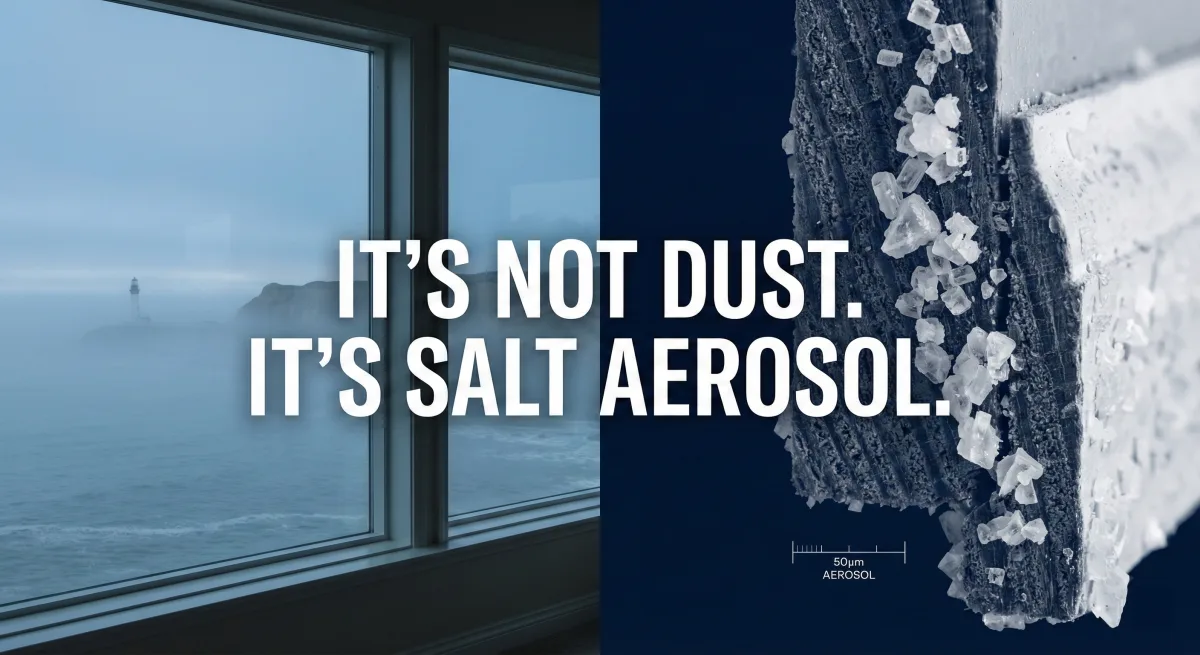
Most homeowners understand that sand scratches floors. Fewer understand that the marine layer is also depositing ionic salt aerosol compounds on their surfaces daily — compounds that don't just dull the finish but actively bond to it. And fewer still recognize that the humidity pattern in coastal zones, particularly during May through September, creates sustained moisture pressure beneath floor finishes that standard maintenance was never designed to address.
The result: premium floors in coastal San Diego homes require a more precise maintenance protocol than the same floors in an inland environment. The threats are real, the chemistry matters, and the most common DIY approaches — wet mopping, vinegar on stone, beater-bar vacuuming — can accelerate the damage they are meant to prevent.
San Diego coastal floors face three simultaneous, chemically distinct threats that require three distinct responses. No single cleaning method addresses all three. Understanding each helps explain why protocol precision matters.
Ionic bonding from NaCl and MgCl₂ marine deposits
Beach sand at Mohs 7 vs. finish at Mohs 2–4
Marine layer moisture cycling beneath floor finishes
The Science: What Each Threat Does to Your Floors
Each of the three coastal floor threats has a distinct mechanism. Knowing which mechanism is at work determines which intervention actually helps. Beach silica registers Mohs 7 on the hardness scale — harder than most floor finishes — making it an effective abrasive even in microscopic quantities.
Ionic deposits from marine layer fog form a hygroscopic film on floor surfaces. The film stays semi-dissolved, trapping dust and silica particles against the finish.
Hardwood finish (dulls), limestone and marble (etching accelerated at bond sites), grout between stone tiles
Continuous in coastal zones; highest during May–June marine layer season
Fine quartz particles track in on foot traffic and act as abrasive grit between foot and floor surface. Hardwood finish rates Mohs 2–3. Stone varies (marble Mohs 3–4, granite Mohs 6–7).
Hardwood finish (micro-scratching, accelerated wear), soft stone (travertine, limestone, marble), grout integrity
Year-round; higher after beach visits, highest in homes within walking distance of sand
Elevated ambient humidity causes wood fiber to absorb moisture, creating expansion pressure beneath the finish layer. In extreme cases, finish lifts or gaps form between planks.
Engineered and solid hardwood (finish lifting, cupping, gapping), unsealed stone (moisture migration, efflorescence)
Seasonal; highest May–September overnight and early morning
Standard mopping introduces water that temporarily dissolves the surface layer of ionic salt deposits. When the water evaporates, the salt recrystallizes in the same position — often in a slightly denser configuration because the water has concentrated it. You have cleaned the appearance without removing the deposit.
At 275°F, dry vapor steam delivers thermal energy that disrupts the ionic bond between the salt compound and the floor surface at the molecular level. The deposit lifts rather than recrystallizing, and the low-moisture vapor carries it away without leaving residual water on the finish. For sealed hardwood, this is the appropriate intervention for salt-film buildup between routine maintenance visits. For stone, it also breaks down any embedded build-up that has formed in grout channels.
To understand the full science of this mechanism, see our steam cleaning science guide and the silica abrasion and Mohs hardness reference.
The Standard Clean: Step-by-Step
What a correct coastal floor maintenance visit looks like — and the common mistakes that undo it.
- 1HEPA vacuum (hard floor setting, beater bar OFF)
Lifts silica and particulate without grinding grit into the finish. 0.3-micron HEPA captures the fine beach sand and I-5 brake dust that standard vacuums recirculate.
- 2Lightly dampened microfiber pass
Pick up the salt-film residue loosened by vacuuming. Cloth should be barely damp — no pooling water on the floor.
- 3Dry vapor steam on salt-bonded areas (if present)
275°F dry vapor on high-traffic areas and near entry points where salt accumulation concentrates. Not appropriate for every visit — assess based on visible film or tackiness.
- 4Dry microfiber pass immediately after steam
Capture the lifted ionic compounds before they redeposit. This step is what separates thermal treatment from redistribution.
- 5Inspect finish condition near exterior doors
Entry zones show first-stage finish wear from silica abrasion. Document to track when professional refinishing becomes appropriate.
- 1Soft-bristle HEPA vacuum or dust mop
Remove grit before introducing any moisture. Abrasive particles caught under a mop head on marble or travertine create micro-scratches that dull the polish surface over time.
- 2pH-neutral stone cleaner (pH 7–9 only)
Apply with a damp microfiber mop. Never use vinegar, citrus cleaners, or multipurpose sprays — their acidity etches calcium carbonate stone permanently.
- 3Grout line inspection for embedded build-up
Dark grout lines in bathroom or kitchen stone floors indicate embedded build-up colonization. This requires professional steam extraction — a mop does not reach inside porous grout channels.
- 4Sealer inspection (annually minimum)
Unsealed or worn-sealer stone is significantly more vulnerable to both salt absorption and moisture penetration. Water drops that soak in rather than bead indicate resealing is needed.
- 5Dry immediately after any wet cleaning
Leave no standing water on stone. Moisture that sits in grout or near unsealed edges can cause efflorescence (white mineral deposits) as it evaporates back through the stone.
Wet mopping hardwood with excess water
Water penetrates seams and finish micro-cracks, reaching wood fiber. Repeated exposure causes finish whitening, plank cupping, and adhesive failure in engineered floors.
Lightly dampened microfiber only. Extract moisture immediately. Professional steam systems use dry vapor — not wet mop equivalents.
Vinegar or citrus-based cleaners on stone
Acid etches calcium carbonate in marble, travertine, and limestone — a chemical reaction that removes the polished surface layer permanently. The damage looks like dull patches that polishing cannot fully restore.
pH-neutral stone cleaner only. No vinegar, no lemon juice, no multipurpose sprays that contain citric acid.
Vacuuming hardwood with a beater bar attachment
The rotating beater bar agitates silica grit into the floor surface rather than lifting it. A single session on silica-laden floors can create hundreds of micro-scratches across the finish.
Hard floor setting on vacuum (beater bar off) or a soft-bristle floor brush. Follow with a damp microfiber pass.
Using the same microfiber cloth on stone and hardwood
Microfiber picks up grit and deposits from each surface and transfers it to the next. Stone grit transferred to hardwood is an abrasive hazard. Hardwood cleaning agents may contain components harmful to stone sealers.
Dedicated microfiber sets per surface type, color-coded. Replace when visibly loaded with particulate.
Highest salt aerosol and humidity exposure. Salt film accumulates visibly within 7–14 days.
Moderate coastal exposure. Stone and hardwood maintain well with consistent monthly professional care.
Lower marine layer contact. Standard dust and particulate accumulation pattern; silica less prevalent.
Why Professional Floor Care Matters in This Environment
The DIY limits are real, and they compound over time. A homeowner who wet-mops hardwood weekly in a La Jolla home is not maintaining the floor — they are contributing to finish degradation, one mop session at a time. The salt film is not removed; it is cycled through a dissolve-and-recrystallize pattern that gradually etches the finish layer.
The distinction between professional and DIY floor care in a coastal environment is calibration. Professional-grade dry vapor steam systems operate at precise moisture output that DIY consumer units do not replicate. The HEPA filtration on commercial vacuums captures 0.3-micron silica particles that household units recirculate. The surfactant chemistry in professional-grade stone cleaners is matched to the specific pH tolerance of calcium carbonate — something that general-purpose retail products ignore entirely.
If your home has investment-grade hardwood, travertine, marble, or slate, the cost of professional maintenance is a fraction of the cost of refinishing or replacement — which is the outcome that incorrect DIY care accelerates. Our deep steam cleaning service specifically addresses the salt aerosol and embedded build-up conditions that coastal floors accumulate between routine visits.
- Dry vapor steam at calibrated 275°F (not wet steam)
- HEPA-13 vacuum filtration for 0.3-micron silica capture
- pH-matched professional-grade stone cleaners
- Color-coded microfiber — no cross-contamination
- Post-service inspection under raking light for finish assessment
- Hardwood finish life — reduce refinishing frequency
- Stone polish and depth — no acid etching from wrong cleaners
- Grout integrity — embedded build-up removal before it requires re-grouting
- Sealer performance — cleaned surface extends sealer life
- Property value — premium floors in excellent condition
The Bottom Line for Coastal Floor Owners
Premium floors in coastal San Diego homes face conditions that don't exist in most of the country. The combination of ionic salt deposition, Mohs 7 silica abrasion, and elevated marine layer humidity creates a maintenance environment that requires calibrated protocol — not just more frequent mopping.
If your floors are showing film, dullness, or embedded build-up in grout that routine cleaning hasn't resolved, that's the signal that the standard approach is no longer sufficient for your environment. Request a quote and describe your floor types — our cleaners will outline the right protocol for your specific surfaces and coastal zone. Also see our San Diego house cleaning pricing guide and our overview of frequently asked questions.
Protect Your Floor Investment
Our cleaners bring professional-grade dry vapor steam, HEPA-13 vacuum equipment, and pH-matched stone cleaners to every floor care visit. We serve La Jolla, Del Mar, Pacific Beach, Coronado, Encinitas, and all coastal San Diego neighborhoods.
Mon–Fri 8 AM – 6 PM | Sat 9 AM – 4 PM | hello@bravomaids.com
Frequently Asked Questions
Why do hardwood floors in coastal San Diego feel sticky or look dull faster than inland homes?
Marine layer fog deposits sodium chloride and magnesium chloride aerosols that settle on horizontal surfaces, including hardwood floors. These hygroscopic salts attract ambient humidity and remain in a semi-dissolved state that creates a tacky film. Combined with fine silica sand tracked in from the beach, the film traps abrasive particles against the finish surface, accelerating dullness. Professional hot-water extraction and 275°F steam treatment address both the ionic salt layer and the embedded abrasives.
Does steam cleaning damage hardwood floors?
Dry vapor steam at 275°F used correctly by trained professionals does not damage sealed hardwood floors. The key distinction is 'dry vapor' — a low-moisture steam that delivers thermal energy without saturating the wood. Wet steam or excess water on hardwood causes warping and finish lifting. Professional-grade dry vapor systems are calibrated to release the temperature needed to break ionic salt bonds while keeping moisture at a level that sealed hardwood tolerates. DIY steam cleaners with high moisture output are not appropriate for hardwood surfaces.
How do I know if my natural stone floors need professional cleaning?
Four indicators: (1) Haze or film that doesn't respond to routine mopping — likely mineral or salt deposit. (2) Grout lines that are darker than their original color — embedded build-up colonization. (3) A dull, flat surface where the stone used to have depth and reflection — surface etching from acidic cleaners or citric acid from food. (4) Visible white efflorescence — moisture migrating through the stone bringing dissolved minerals to the surface. Any of these conditions benefits from professional assessment before they progress to permanent finish damage.
What cleaning products are safe for natural stone floors?
Natural stone — marble, travertine, limestone, and slate — is pH-sensitive. Acidic cleaners (vinegar, lemon juice, many common household multipurpose sprays) etch the calcium carbonate surface, causing permanent dullness. The safe range is pH 7–9, which is why professional cleaning uses pH-neutral or mildly alkaline professional-grade agents matched to the specific stone type. When in doubt: pH-neutral stone cleaner, no vinegar, no citrus-based products.
Ready for a Cleaner Home?
Book your first cleaning today and discover why San Diego families trust Bravo Maids for a healthier, happier home.
Family-owned · Free quotes · Flexible scheduling · 100% satisfaction guaranteed
Why beach sand (Mohs 7) outranks hardwood finish (Mohs 2–3) — the physics of floor wear.
How NaCl and MgCl₂ aerosols deposit on San Diego surfaces — the full seasonal breakdown.
Our Deep Clean protocol — what it includes and when it's the right service for your home.
Last reviewed: October 2026