5 Spots in Your Kitchen & Bath That Only Steam Can Actually Clean (San Diego Guide)
Scrubbing and spraying clean what you can see. 275°F steam cuts through what you cannot. These five zones in your kitchen and bathroom harbor grime, build-up, and allergens that survive every conventional cleaning method — but not steam cleaning.
Jason Ellis, Owner
Bravo Maids San Diego · 8+ years developing high-heat steam clean protocols · Our editorial standards →
Published: May 25, 2026
Why Conventional Cleaning Methods Fail at the Molecular Level
The kitchen and bathroom are the two highest-build-up rooms in any home. NSF International research identifies the kitchen as the room with the most embedded grime on average — ahead of the bathroom. Both rooms share the same problem: build-up doesn't just sit on surfaces. It constructs a barrier.
Embedded build-up is the technical term for this barrier — a matrix of organic and mineral material that accumulates and shields the surface from chemical sprays and physical scrubbing. This build-up is not just a surface layer; it is a structural barrier. Chemical sprays are repelled by its hydrophobic surface. Scrubbing removes the outer layer but leaves the matrix intact. Within 24–48 hours, the build-up re-establishes.
Steam at 275°F — specifically saturated steam at that temperature — defeats embedded build-up through a different mechanism entirely: steam cleaning. High-heat thermal penetration occurs at that threshold, lifting embedded build-up through sustained high-heat cleaning temperatures. The capillary action of steam at pressure drives it into micro-fissures that scrubbing and spraying cannot reach. There is no chemical resistance because there is no chemical.
The Five Zones: Shower grout · Stovetop crevices · Toilet base · Shower door tracks · Faucet aerators. Each one is a build-up zone conventional cleaning methods fail to fully address. See the full science →
Industrial stainless steel boiler delivering 275°F saturated steam — the same equipment used in clinical-grade protocols.
Shower and Bathroom Grout Lines
Why scrubbing failsGrout is porous — its micro-channels are the ideal environment for mold and organic build-up. These organisms construct a protective matrix that acts as a hydrophobic barrier. Chemical sprays run off the surface before they penetrate. Scrubbing removes the visible layer but leaves the embedded build-up intact below. Within 48 hours, the build-up reforms to full depth.
At 275°F, steam uses capillary action to expand into the micro-fissures inside grout. High-heat thermal penetration then lifts embedded build-up — heat drives steam into the matrix, breaking it apart from inside. The embedded build-up releases. San Diego homes near the coast (La Jolla, Pacific Beach, Coronado) see accelerated grout contamination from marine-layer humidity; steam is the only method that addresses the root build-up rather than surface appearance.
San Diego marine-layer humidity creates ideal grout mold conditions year-round.
Stovetop Crevices and Burner Gaps
Why chemical degreasers don't penetrateBaked-on grease isn't just a surface deposit — it polymerizes under heat into a hard, hydrophobic layer that chemically repels water-based degreasers. Every enzyme degreaser you spray runs off the surface before it can break through the grease barrier. Beneath that barrier, grime and build-up accumulate in the warm, oily environment. Standard stovetop cleaning products address the outer layer; the embedded build-up underneath goes untouched.
Steam at 275°F transfers heat directly into the grease layer via conduction, softening and dissolving the hydrophobic barrier without the chemical repulsion problem. Once the barrier breaks, steam penetrates the crevice and steam cleaning lifts the grime and build-up beneath. The result is a stovetop that looks clean because it actually is — not because the residue was pushed somewhere less visible.
Coastal homes with natural ventilation often have greasier stovetops due to airflow across cooking surfaces.
Toilet Base and Behind-Fixture Zones
The moisture trap standard mops missThe caulk line at the base of a toilet, the gap between the tank and the wall, and the underside of the toilet rim are all permanent moisture traps. Standard mopping addresses the floor around the toilet but cannot access these zones. They stay wet between uses, creating ideal conditions for grime and organic build-up that accumulates on moist surfaces for weeks. Sprays reach the surface but cannot penetrate the embedded build-up that forms in porous caulk and tile edges.
275°F steam reaches every crevice a mop head cannot. The high-pressure steam nozzle is angled into the base seal, behind the tank, and along the rim underside. Sustained high-heat cleaning temperatures cut through grime and build-up in toilet embedded build-up zones. There is no residue on surfaces your children and pets contact — just dry, deep-cleaned porcelain.
San Diego water has moderate mineral hardness that accelerates scale buildup around toilet bases.
Shower Door Tracks and Buildup
The mineral-plus-embedded build-up combinationShower door tracks are a dual build-up zone: mineral deposits from hard water (calcium carbonate, magnesium) bind with soap scum to create a nearly impenetrable surface crust. That crust then traps mold growth in its folds. The geometry of the track (a narrow channel with vertical walls) makes physical scrubbing almost impossible without damaging the seal. Chemical sprays address the surface but cannot fully penetrate the mineral-soap matrix.
Steam's combination of heat and pressure dissolves mineral deposits via thermal expansion and hydrolysis, lifting the crust that makes build-up removal possible. Once the mineral barrier breaks, 275°F steam cleaning lifts the embedded mold build-up. The steam nozzle fits into the track geometry that scrub brushes cannot. San Diego's coastal mineral content (higher than inland areas) means track buildup accumulates faster than in most California markets.
Coastal San Diego tap water mineral content accelerates shower track scale buildup.
Faucet Aerators and Mineral Deposits
Where buildup blocks flow and traps mineral depositsFaucet aerators are the most overlooked build-up zone in a kitchen or bathroom. The mesh screens inside aerators trap mineral deposits, organic matter, and grime that accumulates in low-flow environments. Chemical descalers remove visible mineral buildup but do not address the embedded build-up inside the aerator mesh. Standard cleaning protocols never touch the aerator at all.
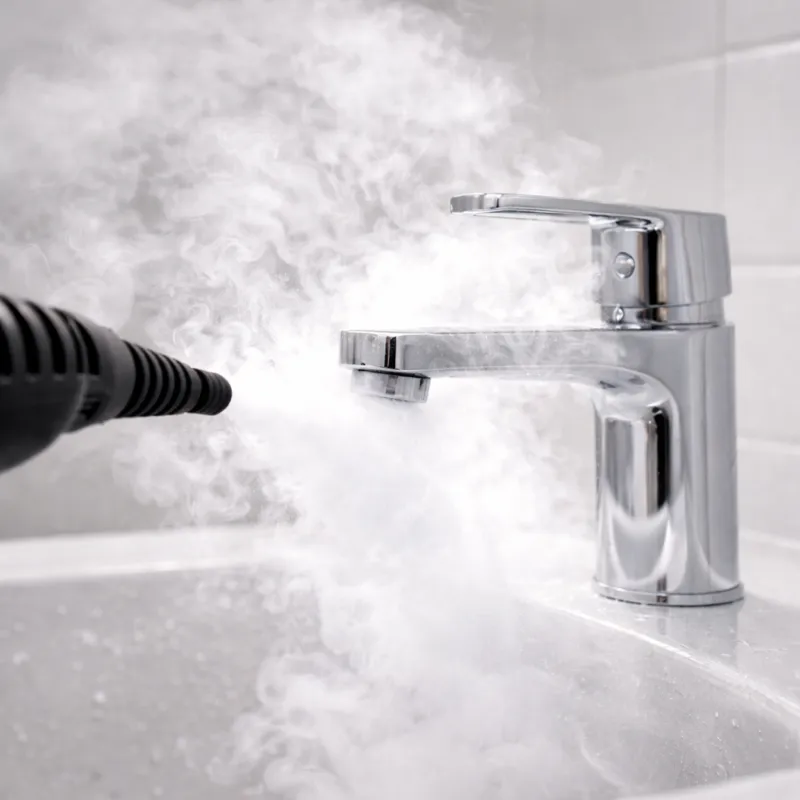
Steam directed at 275°F into the aerator dissolves mineral deposits via thermal hydrolysis and simultaneously deep-cleans the mesh via steam cleaning. The latent heat of vaporization transfers maximum energy on contact — effective in the confined geometry of an aerator screen where spray-based methods cannot reach. Aerator cleaning should be part of any kitchen or bathroom steam service, not an afterthought.
San Diego's moderately hard water (150–200 mg/L hardness) means aerators require attention every 3–4 months.
Just Want the Kitchen and Bathrooms Done?
Our Kitchen & Bath Steam-Blast targets all five zones above — $170 flat for kitchen + 1 bathroom. No whole-home commitment required.
Why San Diego Homes Face a More Aggressive Build-Up Problem
In our experience cleaning hundreds of San Diego homes, our technicians have consistently documented faster build-up reformation in coastal neighborhoods compared to inland areas. San Diego's marine layer creates a persistent humidity condition that accelerates build-up formation in kitchens and bathrooms. The combination of coastal humidity and salt aerosol (sodium chloride and magnesium chloride from ocean spray) creates an environment where mold and grime accumulate faster than in drier inland cities.
La Jolla, Pacific Beach, Coronado, Del Mar, Ocean Beach
Highest marine-layer exposure. Grout and shower track mold develops faster. Salt aerosol accelerates mineral buildup around faucets. Steam treatment every 6–8 weeks recommended.
Mission Valley, Normal Heights, North Park, Hillcrest, Carmel Valley
Moderate marine influence. Quarterly steam treatment typically sufficient. Stovetop and bathroom grout are primary concern zones.
Carlsbad, Encinitas, Solana Beach, Scripps Ranch, Poway
Less marine-layer exposure but freeway particulate (I-5, I-15 corridors) creates interior dust and surface contamination. Quarterly kitchen steam treatment recommended.
Frequently Asked Questions
Why doesn't scrubbing remove grout stains in San Diego bathrooms?
Grout is porous — its micro-channels harbor mold and organic build-up that embed deep below the surface. Scrubbing and chemical sprays only address the top layer; the embedded build-up survives intact. 275°F steam uses capillary action to penetrate those micro-channels, then steam cleaning lifts embedded build-up. San Diego's coastal humidity accelerates mold and build-up growth in bathroom grout.
What is the best way to clean stovetop crevices?
275°F steam is the only method that effectively removes baked-on grease from stovetop crevices. Baked-on grease creates a hydrophobic barrier that repels chemical degreasers — the product runs off before it can penetrate. Steam dissolves the grease barrier via direct heat transfer, then lifts the grime and build-up beneath it.
How often should I steam clean my kitchen and bathroom in San Diego?
Quarterly steam treatment is the minimum for most San Diego homes. Coastal homes (La Jolla, Pacific Beach, Coronado, Del Mar) benefit from every-other-month treatment due to accelerated build-up and mineral accumulation from marine-layer humidity and salt aerosol.
- Kitchen & Bath Steam-Blast — $170 Flat Rate (San Diego) — Our standalone kitchen and bathroom steam service
- 275°F Steam Science — Embedded Build-Up Disruption — The physics behind high-heat breakdown and capillary action
- Grout Steam Cleaning Science — Why grout is an embedded build-up trap and what steam cleaning does
- Kitchen Deep Clean: Fridges & Ovens San Diego — Inside-appliance degreasing protocols
- Clinical-Grade Steam Cleaning San Diego — Full-home 275°F steam protocol with HEPA-13 extraction
Ready to Actually Clean These Five Zones?
The Kitchen & Bath Steam-Blast targets all five zones in one visit — $170 flat for kitchen + 1 bathroom. No whole-home commitment. No upsell at the door.
Additional bathrooms +$50 each · Mon–Fri 8AM–6PM · Sat 9AM–4PM
Ready for a Cleaner Home?
Book your first cleaning today and discover why San Diego families trust Bravo Maids for a healthier, happier home.
Family-owned · Free quotes · Flexible scheduling · 100% satisfaction guaranteed
Last reviewed: October 2026