Move-Out Cleaning Checklist for San Diego Landlords
Last updated:
Published May 2026 · By Jason Ellis, Clinical Director
Summary
California Civil Code Section 1950.5 requires landlords to return security deposits within 21 calendar days and limits cleaning deductions to conditions that exceed ordinary wear and tear. Landlords can legally deduct only for cleaning that restores the unit to its move-in condition — not for gradual deterioration from normal use. A dated, itemized receipt from a professional cleaning service is the strongest documentation for defending any cleaning deduction in a San Diego deposit dispute.
Why San Diego Homeowners Choose Bravo Maids
- $2M Insured & Background-Checked Specialists — Full liability coverage on every job — every Certified Cleaning Specialist passes comprehensive background screening before entering your home.
- 275°F Steam-First Clinical Protocol — Saturated steam at 275°F delivers thermal shock that lifts embedded build-up and cuts through grime — no chemical residue left behind.
- Satisfaction Guaranteed — Re-Clean Free — Not satisfied? Contact us within 24 hours and we'll return to re-clean the area at no additional charge. Zero risk.
- Easy Online Booking in Under 60 Seconds — Book a Standard Shine, Top-to-Bottom Deep Clean, or Move-Out Clean online anytime. Same-week availability for most San Diego households.
California Civil Code 1950.5: What Landlords Need to Know
California is among the most tenant-protective states in the country when it comes to security deposits. California Civil Code Section 1950.5 establishes the framework that governs every San Diego rental — from a studio in North Park to a single-family home in Del Mar. Understanding it is not optional for landlords who want to make defensible cleaning deductions.
The 21-Day Rule
After a tenant vacates, landlords have exactly 21 calendar days to either return the full deposit or send the tenant an itemized written statement of deductions along with copies of receipts for any third-party work (cleaning, repairs). If you use your own labor, the law still requires an itemized statement with the time spent and the hourly rate charged.
Missing the deadline has serious consequences. California courts have interpreted a late or incomplete deposit return as a bad faith act, which can expose landlords to damages of up to twice the deposit amount — on top of returning the deposit itself.
Ordinary Wear and Tear vs. Actual Uncleanliness
This is the most litigated distinction in California landlord-tenant law. Ordinary wear and tear refers to the inevitable, gradual deterioration that occurs through normal, everyday living — light scuffs on baseboards, faint carpet impressions from furniture legs, minor dust accumulation on surfaces. Landlords cannot deduct for these conditions regardless of the cleaning cost involved.
Actual uncleanliness — the kind that warrants a deduction — involves conditions beyond what normal tenancy produces: grease buildup inside an oven or range hood, mold from inadequate ventilation or neglect, pet-related odor saturation in flooring or walls, or surfaces left visibly soiled beyond normal use. The legal test is whether the cleaning is necessary to return the unit to the condition it was in at move-in, adjusted for the natural passage of time. Understanding full tenant rights and landlord obligations under California law helps both parties navigate these disputes correctly.
Key provisions of California Civil Code 1950.5:
- •Deposit must be returned within 21 calendar days of tenant move-out
- •Deductions must be accompanied by an itemized written statement and receipts
- •Cleaning deductions are limited to restoring move-in condition (minus wear and tear)
- •Landlords cannot charge to restore a unit to a condition better than it was at move-in
- •Bad-faith withholding can result in a penalty of up to two times the deposit amount
- •Residential security deposits are capped at two months’ rent (unfurnished) or three months’ (furnished) as of 2024
This article is for informational purposes only and does not constitute legal advice. San Diego landlords with specific deposit disputes should consult a licensed California attorney.
Room-by-Room Inspection Checklist
The table below reflects the areas San Diego landlords and professional cleaners most frequently cite in deposit disputes, mapped to the professional standard required and whether a deduction is typically defensible if the condition is not addressed.
| Room / Area | What Landlords Check | Professional Standard Required | Deductible if Not Done? |
|---|---|---|---|
| Kitchen | Oven interior (including glass door and broiler drawer), range hood filters, stovetop drip pans, cabinet faces and interiors, countertops, sink, backsplash grout, floor corners | All grease removed from oven walls, hood, and burners; cabinet shelves wiped clear; countertops and sink free of residue; floor mopped including under appliances | Yes — high dispute risk |
| Bathrooms | Toilet exterior and interior bowl, shower/tub grout and tile, showerhead and faucet mineral deposits, exhaust fan cover, mirror, sink drain stopper, floor corners and baseboard behind toilet | Grout lines free of soap scum and mildew; toilet cleaned including base and behind tank; all tile surfaces wiped; exhaust fan cover dust-free; no mineral scale on faucets | Yes — high dispute risk |
| Bedrooms | Closet interiors (floors and shelves), window sills and tracks, ceiling fan blades, baseboards, carpet or flooring condition, under-bed debris, door handles and light switch plates | Closet floors swept and shelves wiped; window sills and tracks free of dust and debris; carpet vacuumed or hard floors mopped; baseboards dusted; ceiling fan blades cleaned | Conditional |
| Living Areas | Baseboards and crown molding, window sills and blinds or curtain rods, light switch plates and outlet covers, glass surfaces and sliding door tracks, fireplace surround if present, floor condition under furniture positions | Baseboards dusted and wiped; blinds vacuumed or wiped; sliding door tracks cleared of debris; glass surfaces streak-free; flooring mopped or vacuumed including corners | Conditional |
| Common Areas | Hallways and stairways, laundry room or hookup area, garage interior if included in lease, utility closet, entryway and door thresholds | Floors swept and mopped; laundry surfaces wiped including washer and dryer drum interiors if applicable; entryway free of dirt and debris | Conditional |
| Appliances | Refrigerator interior and exterior, dishwasher filter and door seal, microwave interior and turntable, oven (all interior surfaces), range hood underside, any tenant-left appliances | Refrigerator shelves and drawers wiped; dishwasher filter cleared; microwave interior free of splatter; all appliances free of food residue and odor | Yes — high dispute risk |
| Windows | Interior glass surfaces, window tracks and weep holes, sill surfaces, screens if present, any salt aerosol deposit on coastal-facing windows common in San Diego coastal neighborhoods | Interior glass streak-free; tracks clear of silt and debris; sills wiped; screens free of visible dirt buildup. Exterior cleaning is typically not a tenant obligation unless specified in the lease. | Interior only, conditional |
“Conditional” means deductible only if the condition demonstrably exceeds normal wear and tear relative to the move-in condition documented for that unit.
What Landlords Can — and Cannot — Deduct for Cleaning
California courts apply the ordinary wear and tear doctrine strictly. The following breakdowns are based on patterns from California small claims decisions and guidance from the California Department of Consumer Affairs. They are not legal advice, and individual cases vary.
Landlords CAN Deduct For:
- ✓Grease buildup inside the oven, broiler, and range hood beyond what normal cooking produces
- ✓Refrigerator shelves with food residue, spills, or odors requiring deodorizing
- ✓Bathroom tile grout with mold or soap scum accumulation beyond normal use
- ✓Pet odor saturation in carpet, flooring, or walls requiring professional odor treatment
- ✓Excessive garbage or belongings left in the unit at move-out
- ✓Biological contamination (insect infestation, rodent evidence) attributable to tenant behavior
- ✓Flooring with stains or burns that go beyond normal traffic patterns
- ✓Cleaning costs only up to the actual condition difference from move-in, supported by documentation
Landlords CANNOT Deduct For:
- ✗Light dust on surfaces or window sills from normal habitation
- ✗Carpet impressions or minor wear from furniture in normal positions
- ✗Paint touch-ups for minor scuffs from normal everyday use over a long tenancy
- ✗Cleaning the unit to a standard cleaner than it was at move-in
- ✗Full carpet replacement due to normal traffic wear (absent documented damage)
- ✗Cleaning costs incurred because the landlord wanted to renovate or upgrade between tenancies
- ✗Flat-fee or blanket cleaning charges not supported by an itemized breakdown
- ✗Any deduction made without written itemization and supporting receipts sent within 21 days
One pattern that courts scrutinize closely: a landlord who conducts no move-in inspection, has no photos, and then claims substantial cleaning deductions at move-out. Without a baseline move-in condition record, the deduction is nearly impossible to defend. California law allows tenants to request an initial inspection before they vacate — during which the landlord must identify deficiencies in writing so the tenant has an opportunity to address them. Landlords who skip this step lose significant leverage in any subsequent dispute.
Why Professional Documentation Matters: The Cleaning Receipt
Most San Diego landlords understand that cleaning deductions require receipts. Fewer understand what kind of documentation actually holds up in a dispute — and why a generic invoice for “cleaning services” often fails to satisfy a judge or mediator.
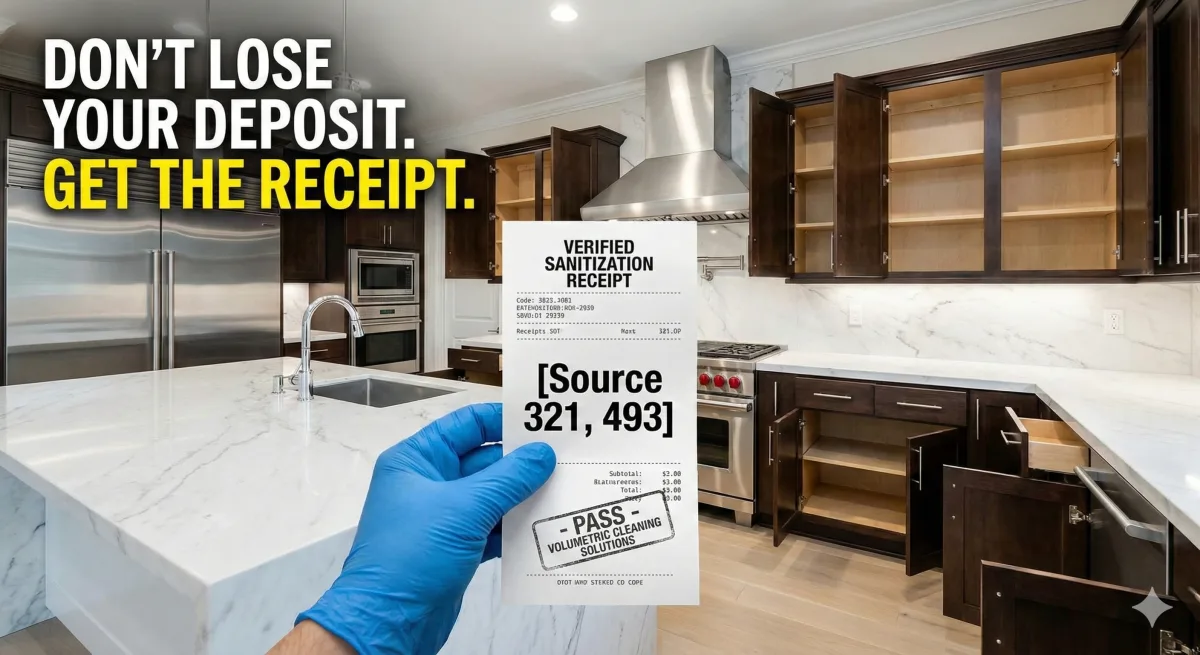
A Cleaning Receipt is a detailed, dated PDF issued by a professional cleaning service that documents the specific areas treated, the methods used, and the condition of the unit at the time of service. Unlike a generic invoice with a flat price, a Cleaning Receipt creates an area-by-area record that mirrors the line-item structure that California courts expect to see when evaluating the reasonableness of a deposit deduction.
What a Cleaning Receipt typically documents:
The order the work happens in matters as much as the list itself. Appliance interiors and mineral scale on glass need dwell time, and floors have to come last or they get walked again — which is why a room-by-room record reads as thorough to a mediator while a flat invoice does not. This San Diego move-out cleaning guide walks the inspection route in the order a property manager actually follows it.
When a tenant disputes a cleaning deduction, a Cleaning Receipt submitted alongside move-in and move-out photos provides the three-part documentation set that California courts typically expect: a baseline condition (move-in), an end condition (move-out), and proof that the cost of restoration was reasonable and actually incurred.
Landlords who use professional cleaning services for every turnover — even when the tenant cleaned themselves — have a significant advantage in dispute situations. The deduction is supported by a dated, third-party document rather than a landlord’s personal assessment of cleanliness. San Diego move-out cleaning services that include a formal Cleaning Receipt are specifically designed to meet this evidentiary standard. For a deeper look at how California’s deposit compliance requirements interact with cleaning standards, see California security deposit cleaning compliance.
Landlord Pre-Move-Out Inspection Protocol
California law entitles tenants to an initial inspection within two weeks of their stated move-out date. Landlords who proactively conduct — and document — this inspection are better positioned legally and practically. Here is a protocol that supports compliance with Civil Code 1950.5.
Schedule the Initial Inspection in Writing
Notify the tenant of their right to an initial inspection in writing. Confirm the date and time and give the tenant at least 48 hours’ notice. California law requires this. Document that the notice was given.
Use a Standardized Condition Report
Walk each room with a checklist and a camera. Record the condition of every surface — not just obvious damage. Note the oven, refrigerator, grout, window tracks, and closet interiors. These are the areas most frequently cited in deposit disputes.
Provide a Written Deficiency List
If conditions are found that would result in a cleaning deduction, California law requires you to give the tenant a written statement of the deficiencies before they move out — so they have the opportunity to address them. A landlord who withholds this list and then charges for the same items has weak standing.
Document the Final Move-Out Condition
Conduct a final walkthrough on or after the move-out date with the same checklist used at move-in. Photograph any area you intend to include in a deduction. Time-stamp your photos. Do not clean the unit before documenting the move-out condition.
Commission Professional Cleaning with a Cleaning Receipt
Hire a professional cleaning service and request a Cleaning Receipt that documents all areas treated. This receipt, together with your move-in and move-out photos, forms the core of your documentation package.
Send the Itemized Statement Within 21 Days
Mail or deliver the itemized deposit disposition to the tenant’s last known address or forwarding address within 21 calendar days of move-out. Include copies of all receipts. Keep proof of mailing (certified mail is advisable).
San Diego-Specific Note
Coastal San Diego rentals — particularly those in La Jolla, Coronado, Pacific Beach, and Del Mar — face an additional cleaning challenge that inland properties do not: salt aerosol deposition. Marine-layer humidity combined with ocean air introduces airborne sodium chloride that deposits on window tracks, door hardware, and metal fixtures. During a move-out inspection, landlords should distinguish between ordinary salt aerosol accumulation (non-deductible wear and tear in a coastal environment) and actual neglect-related buildup. Professional cleaning services familiar with San Diego coastal properties understand this distinction and document it accordingly.
Frequently Asked Questions
How long does a California landlord have to return a security deposit?+
Can a landlord charge for cleaning even if the tenant cleaned the apartment?+
What documentation should a San Diego landlord keep to defend cleaning deductions?+
Is 'ordinary wear and tear' ever a reason to deny a cleaning deduction in California?+
Does California require professional cleaning before move-out?+
Tenants preparing to move out should follow our renter’s move-out cleaning checklist for a room-by-room guide to passing landlord inspection and protecting their security deposit.
Additional guidance is available on the Bravo Maids FAQ page.
Ready for a Professionally Documented Move-Out Clean?
Bravo Maids Certified Cleaning Specialists provide move-out cleaning throughout San Diego County — and every service includes a Cleaning Receipt designed to meet California Civil Code 1950.5 documentation standards.
Flat-rate pricing. No hidden fees. Available in La Jolla, Coronado, Del Mar, Pacific Beach, North Park, Hillcrest, and surrounding San Diego neighborhoods.
Request Move-Out CleaningOr call us at (619) 853-3200 to discuss your property’s specific needs.
Ready for a Cleaner Home?
Book your first cleaning today and discover why San Diego families trust Bravo Maids for a healthier, happier home.
Family-owned · Free quotes · Flexible scheduling · 100% satisfaction guaranteed
Last reviewed: August 2026