San Diego Rental Code & High-Density Housing Cleaning Standards: What Property Managers & Residents Need to Know
The short answer: San Diego Municipal Code Title 4 sets enforceable cleanliness standards for rental properties. City inspectors focus on pest prevention, surface condition, and ventilation — all of which require professional deep cleaning to maintain consistently. This guide covers the code sections, inspection triggers, and the cleaning protocol that keeps UTC properties compliant.
University City's high-density apartment stock — from the student housing clusters along Regents Road to the biotech worker complexes near the Genentech campus on Townsend Way — sits in a unique regulatory environment. The combination of transient occupancy, biotech employment, and proximity to research institutions means UTC properties face above-average scrutiny from San Diego's Code Compliance division and County Environmental Health inspectors.
Most property managers and residents understand that cleaning matters for security deposit recovery. Fewer understand that San Diego Municipal Code makes specific cleaning standards legally enforceable — and that certain inspection triggers can generate mandatory professional cleaning orders regardless of a property's baseline condition. This guide covers the code sections, the inspection logic, the air quality thresholds, and the move-out checklist that San Diego Housing Board proceedings actually use.
What San Diego Code Sections 4.0103–4.0107 Require for Rental Properties
San Diego Municipal Code Title 4 (Housing & Building Regulations) governs rental property cleanliness standards enforced by the City's Code Compliance division. Three sections are directly relevant to UTC landlords and tenants:
Section 4.0103(a) — Pest Prevention
“All rental units must maintain effective pest and rodent prevention.” City inspectors have established that “effective prevention” requires a clean baseline. Food residue accumulation, organic matter in kitchen crevices, and moisture in bathroom grout create nesting and feeding conditions that constitute a Section 4.0103 violation. A documented inspection failure in a UTC high-rise (2024) cited grease accumulation behind a stove as a pest-attractant violation — the landlord was required to engage professional cleaning contractors as a condition of re-certification.
Section 4.0105(b) — Surface and Appliance Condition
“All surfaces, fixtures, and appliances shall be clean and in good working order.” City inspectors interpret this section as requiring professional-grade cleaning at a minimum annual frequency for multi-unit buildings. The reasoning: resident cleaning schedules are inconsistent and do not cover the inspection points inspectors actually review — duct condition, appliance interiors, grout seams, light fixture interiors. DIY cleaning does not satisfy the inspection standard for these items.
Section 4.0107 — Ventilation
“Ventilation and air circulation shall not be impeded.” UTC apartments use shared HVAC systems with individual unit air handlers. Accumulated dust in duct channels and clogged HVAC filters reduce airflow below code-required minimums — triggering 4.0107 notices even in units that appear otherwise clean. A filter changed by a resident every few months is not sufficient; duct interior condition is the inspection standard.
For UTC property managers, an annual professional deep clean directly addresses all three code sections in a single service visit. It also creates the documented evidence trail that demonstrates compliance proactively — reducing exposure to surprise citation notices.
Why High-Density Zones Like University City Face More Frequent Code Inspections
San Diego County Environmental Health & Quality division (EHQ) conducts inspections on a complaint-triggered basis, with targeted review in high-density zones. UTC's combination of high-density residential, student and transient occupancy, and proximity to biotech employment creates an above-average complaint profile — which means UTC property managers face more frequent triggered inspections than comparable mid-density neighborhoods.
Mold Complaint
Any resident complaint triggers building-wide professional assessment, remediation, and clearance inspection before the Notice to Comply is closed. The cost — including inspector fees, contractor fees, and re-inspection — typically exceeds $2,000 per building.
Pest Report
Cockroaches, rodents, or bed bugs trigger building-wide deep clean as a condition of exterminator certification. Extermination alone is insufficient — EHQ requires the pest-attractant conditions (food residue, organic matter) to be professionally addressed before re-certification.
Odor Allegation
Odor complaints from adjacent units or common areas trigger HVAC inspection and professional cleaning before the inspection pass. HVAC-sourced odors — common in UTC buildings with shared air handlers — require duct cleaning and filter service, not surface cleaning alone.
Security Deposit Dispute
A formal Housing Board complaint requires documented unit condition for adjudication. City proceedings often result in mandatory professional cleaning orders to establish a documented baseline before the dispute can be resolved.
The reactive math for UTC property managers: A single triggered inspection generates a citation fine ($500–2,000), a mandatory re-inspection fee, and required professional cleaning under a deadline — total reactive cost typically exceeds $3,000 per incident. A proactive annual professional deep clean at $285–375 per unit eliminates all three costs for the large share of incidents that originate from preventable cleaning conditions.
Indoor Air Quality Thresholds That Apply to UTC's Dense Apartment Buildings
San Diego County Public Health Officer's environmental health guidelines (updated 2025) set indoor air quality thresholds applicable to buildings with 8 or more units — which covers the majority of UTC's apartment stock. These thresholds create an additional compliance layer beyond the Municipal Code cleaning standards.
Carbon Dioxide: ≤1,000 ppm
Per California Title 24 and San Diego building code. Exceeded CO₂ in a sealed apartment indicates ventilation failure — most commonly caused by blocked HVAC airflow from filter accumulation and duct dust buildup. A HEPA deep clean that includes HVAC verification directly addresses this threshold.
Particulate Matter: ≤35 μg/m³
Per SDAQMD (San Diego Air Quality Management District) standards for indoor residential spaces. UTC apartments near Rose Canyon Open Space see seasonal PM2.5 elevation from canyon-wind micro-dust migration during summer inversion months — professional HEPA cleaning combined with duct service is required to maintain this threshold without continuous air purification.
Mold Spore Count: ≤200 CFU/m³
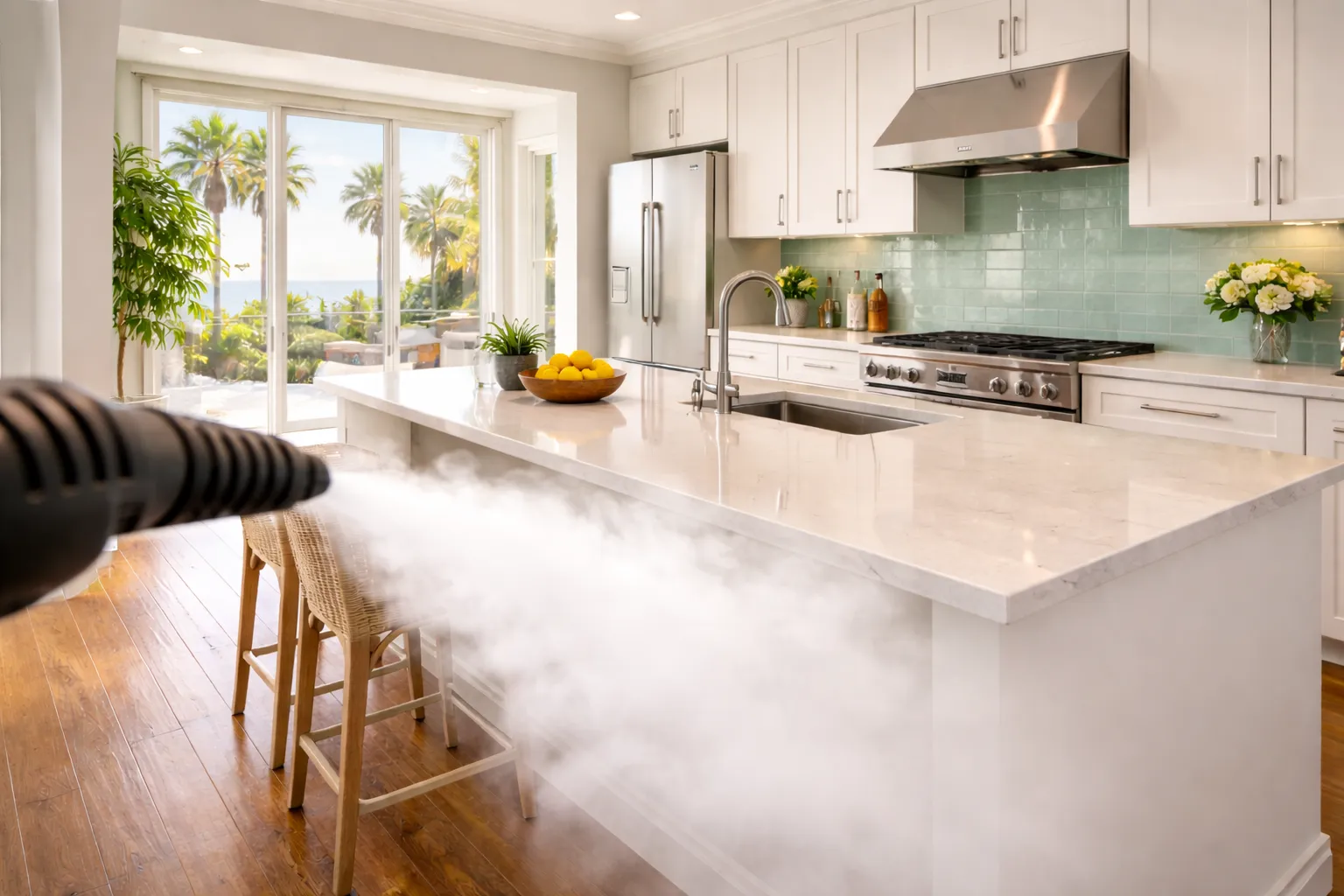
San Diego County Environmental Health recommends indoor mold counts below 200 colony-forming units per cubic meter in residential spaces. Bathroom grout mold in high-humidity UTC units — many of which lack independent exhaust fans — can push counts well above this threshold. The formal citation trigger is a resident complaint, but the underlying condition constitutes a code violation before the complaint is filed. A professional deep clean built around 275°F thermal-shock steam on wet-zone fixtures — sinks, showers, toilets, and tubs — targets exactly where this mold originates; lifting the embedded build-up may reveal a brighter grout line, though results vary by surface condition.
For UTC property managers and corporate landlords managing multiple units: an annual HEPA deep clean with HVAC service maintains all three thresholds within compliance range, reduces reactive inspection liability, and documents due diligence for property insurance purposes.
What San Diego and California Code Requires at Move-Out: The Full Inspection Checklist
California Civil Code Section 1950.5 and San Diego's supplementary housing code govern move-out cleaning and security deposit deductions. The San Diego standard move-out checklist — as applied by City Housing Board proceedings — is more comprehensive than most residents realize. Here is what inspectors actually examine:
Residents who self-clean before move-out and rely on their own judgment about what is “clean enough” routinely miss four or five of these inspection points. A professional deep clean covers all eight categories in a single visit — and provides written documentation that any subsequent deduction claim must specifically contradict.
The ROI of Professional Deep Cleaning for UTC Property Managers and Renters
For Property Managers
Annual professional deep clean reduces City citation risk, maintains all three air quality thresholds, and creates documentation for insurance due diligence. The reactive math is straightforward:
- ✗One citation: $500–2,000 fine + re-inspection fee + mandatory professional cleaning on a deadline = $3,000+ reactive cost
- ✓Annual proactive deep clean per unit at $285–375 = prevention cost
Frequency recommendation for UTC buildings: Q1 (January–March, post-winter humidity accumulation) and Q3 (July–September, post-summer dust, before fall leasing season) — minimum twice annually for code compliance maintenance.
For UTC Renters
A professional deep clean before move-out is the single most effective deposit recovery strategy available under San Diego law. California Civil Code requires landlords to itemize deductions within 21 days — a documented professional clean eliminates “insufficient cleaning” as a viable deduction basis.
- ✓1-bedroom / 1-bathroom deep clean: $285
- ✓2-bedroom / 2-bathroom deep clean: $375
- ✓Typical UTC security deposit: $1,700–2,500
The break-even on professional cleaning is under one-fifth of the deposit at risk — and the documentation shifts the burden of proof onto any cleaning deduction the landlord attempts to make.
What Bravo Maids Documents After Every Service
Bravo Maids provides written service confirmation after every UTC deep clean, including: service date, scope of work performed by room and area, HEPA equipment specification, HVAC filter status noted, and any pre-existing conditions documented. This is the documentation format that holds up in San Diego Housing Board deposit dispute proceedings — and the same format that satisfies City Code Compliance requirements for professional cleaning contractor verification.
For property managers scheduling annual compliance cleans, the service confirmation serves as the audit trail for City inspectors and insurance carriers. For renters using the service before move-out, it is the counter-document to any landlord deduction claim.
For UTC property managers operating high-density apartments or property owners preparing for City inspection, apartment cleaning services University City provides code-compliant professional deep cleaning with written documentation of scope and equipment — the standard San Diego inspectors and Housing Board proceedings require.
Frequently Asked Questions
What does San Diego Municipal Code require for rental property cleanliness?▾
San Diego Municipal Code Title 4 (Housing & Building Regulations) Sections 4.0103–4.0107 set minimum sanitation standards for rental properties: effective pest prevention (requiring a clean baseline), surfaces and fixtures in good working order and clean, and ventilation not impeded. City housing inspectors interpret Section 4.0105(b) as requiring professional-level cleaning at least annually for multi-unit residential buildings.
How often does San Diego County inspect high-density apartment buildings?▾
San Diego County Environmental Health & Quality division conducts inspections on a complaint-triggered basis, with targeted review in high-density zones including UTC. Triggers include mold complaints, pest reports, odor allegations, and security deposit disputes — all of which require professional-level deep cleaning before re-certification.
What are the most common reasons UTC landlords withhold security deposits for cleaning?▾
The most commonly cited issues per San Diego Housing Board dispute records: inadequate carpet and floor cleaning, wall staining not remediated, appliance interior grime (refrigerator coils, stove hood), bathroom grout and caulking mold, HVAC filter replacement skipped, light fixture interior buildup, and persistent odor in HVAC systems.
Does a professional deep clean actually help recover a security deposit?▾
Yes. Professional deep cleaning with written documentation of scope and equipment significantly reduces landlord-tenant cleaning disputes. California Civil Code requires landlords to provide an itemized deduction list within 21 days of move-out. A documented professional clean gives tenants a strong counter-position for any cleaning-related deductions — and in many cases eliminates cleaning as a viable deduction basis entirely.
Schedule your UTC property compliance cleaning — we'll document scope and HVAC status for code compliance records and security deposit defense.
Schedule UTC Compliance CleaningReady for a Cleaner Home?
Book your first cleaning today and discover why San Diego families trust Bravo Maids for a healthier, happier home.
Family-owned · Free quotes · Flexible scheduling · 100% satisfaction guaranteed